
It was on this week in 1845 that literary history was changed forever, after a seemingly innocuous event. On 9th October 1845 Emily wrote her fine poem ‘The Visionary’ in her secret poetry manuscript and then locked it away from the world, as she had done for many years. The following day, 10th October, Charlotte ‘accidentally’ discovered the manuscript, and later detailed what came next:

‘One day, in the autumn of 1845, I accidentally lighted on a manuscript volume of verse in my sister Emily’s handwriting. Of course, I was not surprised, knowing that she could and did write verse: I looked it over, and something more than surprise seized me, – a deep conviction that these were not common effusions, nor at all like the poetry women generally write. I thought them condensed and terse, vigorous and genuine. To my ear, they also had a peculiar music – wild, melancholy, and elevating.
My sister Emily was not a person of demonstrative character, nor one, on the recesses of whose mind and feelings, even those nearest and dearest to her could, with impunity, intrude, unlicensed; it took hours to reconcile her to the discovery I had made, and days to persuade her that such poems merited publication. I knew, however, that a mind like hers could not be without some latent spark of honourable ambition, and refused to be discouraged in my attempts to fan that spark to flame.’

The result was a huge row, but after Emily’s much loved younger sister Anne suggested the three sisters pool their poetry and try to have it published it led to the very first Brontë book: Poems by Currer, Ellis and Acton Bell. In today’s post we look at a seasonal poem by Emily which didn’t feature in that collection.
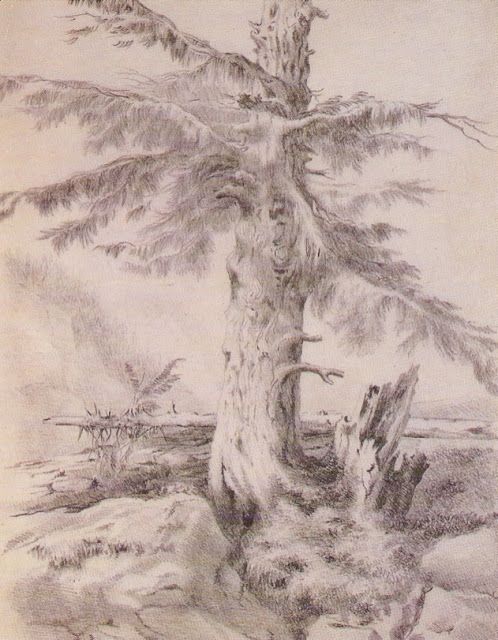
Early October heralds Autumn, and in churches across Yorkshire and beyond it heralds Harvest Festivals – I’ve been to one myself earlier today. At the top of this post we have an Autumnal landscape drawn by Anne Brontë. We therefore rather fittingly look now at Emily’s fine poem ‘I know that to-night the wind is sighing’ with its autumnal harvest imagery:
‘I know that to-night the wind it is sighing,
The soft August wind, over forest and moor;
While I in a grave-like chill am lying
On the damp black flags of my dungeon floor.
I know that the harvest-moon is shining;
She neither will soar nor wane for me;
Yet I weary, weary, with vain repining,
One gleam of her heaven-bright face to see.
For this constant darkness is wasting the gladness,
Fast wasting the gladness of life away;
It gathers up thoughts akin to madness,
That never would cloud the world of day.
I chide with my soul—I bid it cherish
The feelings it lived on when I was free,
But sighing it murmurs, ‘Let memory perish,
Forget, for my friends have forgotten me.’
Alas! I did think that they were weeping
Such tears as I weep—it is not so!
Their careless young eyes are closed in sleeping;
Their brows are unshadowed, undimmed by woe.
Might I go to their beds, I’d rouse that slumber,
My spirit should startle their rest and tell,
How hour after hour, I wakefully number,
Deep buried from light in my lonely cell!
Yet let them dream on; tho’ dreary dreaming
Would haunt my pillow if they were here;
And I were laid warmly under the gleaming
Of that guardian moon and her comrade star.
Better that I my own fate mourning,
Should pine alone in this prison gloom;
Then waken free on the summer morning
And feel they were suffering this awful doom.’
Emily Brontë mentions a fine August wind, because she wrote and dated it in August 1845 – perhaps the wind was really sighing as she looked out of her window, quill or dip pen in hand? It’s a familiar theme of captivity for Emily, coupled with the nature imagery she loved in reality and in her imagination.
Emily Brontë’s poetry has proved a rich harvest for literature lovers ever since Charlotte Brontë made that ‘chance’ discovery. May your harvest be an equally bountiful one, and I hope to see you next Sunday for another new Brontë blog post.