
Halloween is just too good to limit to one day, so as we are on the 1st of November, All Saint’s Day followed by All Souls Day tomorrow when we remember the departed of this world, let’s have our annual Halloween Brontë blog.

You may remember that in previous years we’ve looked at the devil dog gytrash at Ponden Hall, the ghost that terrorised the Branwells of Penzance, the sighting of Anne Brontë on a Long Island staircase, and the giggling ghost of Emily Brontë in a Haworth guesthouse.
Charlotte Brontë, as we know, was a brilliant writer, and a hard worker: she hated to be left with nothing to do. Perhaps that’s why there is not just one, but at least two reported locations for her ghost to be seen: and neither is in Haworth.
We reported previously about Charlotte Brontë’s ghost being seen in Hathersage Vicarage in the Derbyshire Peak District. Charlotte stayed there with Ellen Nussey in 1845 as they prepared it for occupation by its new vicar, Ellen’s brother Reverend Henry Nussey.
Her time in Hathersage provided a location and characters for Jane Eyre, and it must have meant a lot to Charlotte for it was reported in 1927 that Charlotte’s ghost made an annual appearance in Hathersage Vicarage, terrifying the incumbent Reverend Brooksbank’s dog.
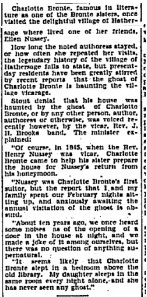
Reverend Brooksbank denied this story, but we now have an update – from a 1928 report in the Halifax Courier. It seems that people were preparing for Charlotte’s visit to Hathersage again, as it always occurred in February. This report, it has to be said, should perhaps be taken with a pinch of salt as it claims that Hathersage is in Yorkshire, and that Charlotte and Ellen visited there in 1854.
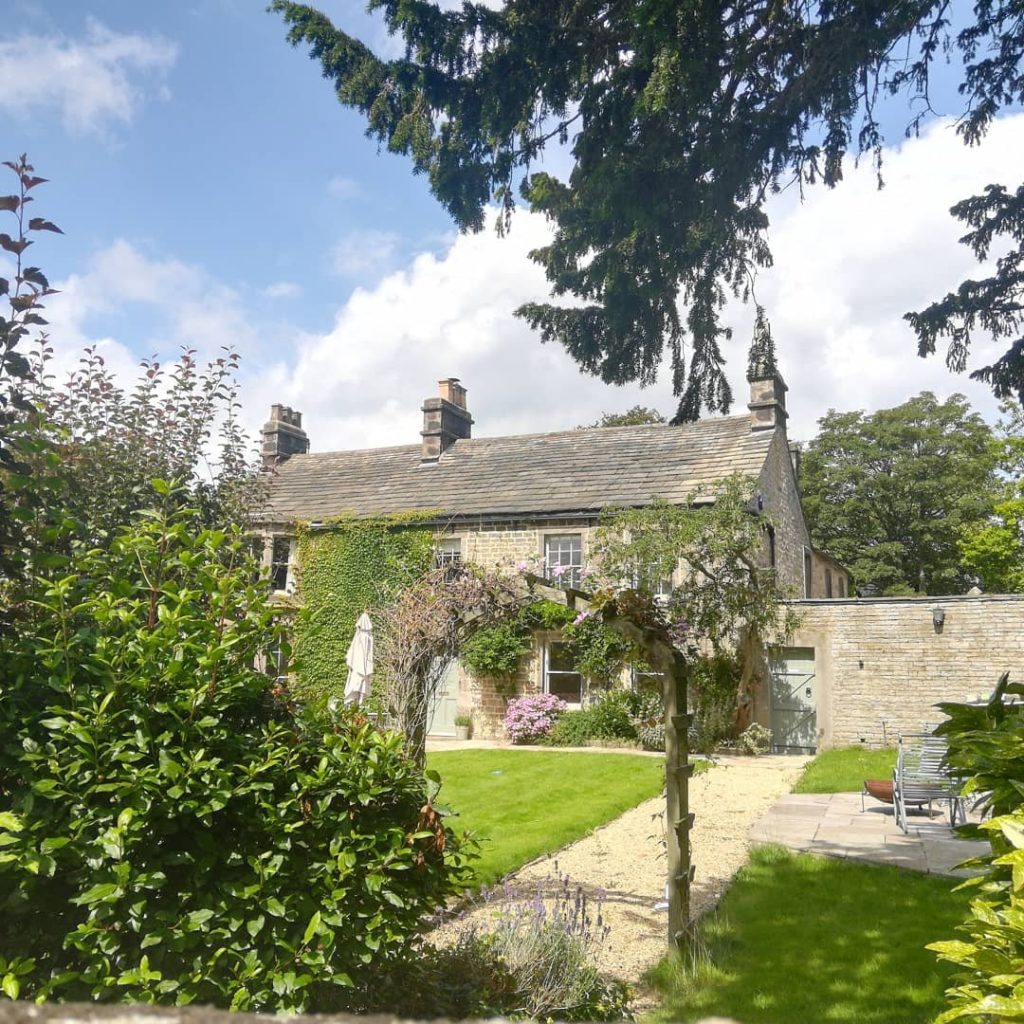
So, there can be little doubt, ahem, that Charlotte’s ghost was seen in Hathersage, but where was the second location? For that we head 60 miles north from the beautiful Derbyshire village, passing Haworth on the way, to Stonegappe Hall (sometimes styled Stone Gappe) near Skipton in North Yorkshire. It was one of the grand homes owned by the wealthy Sidgwick family, and can be seen at the head of this post and below.
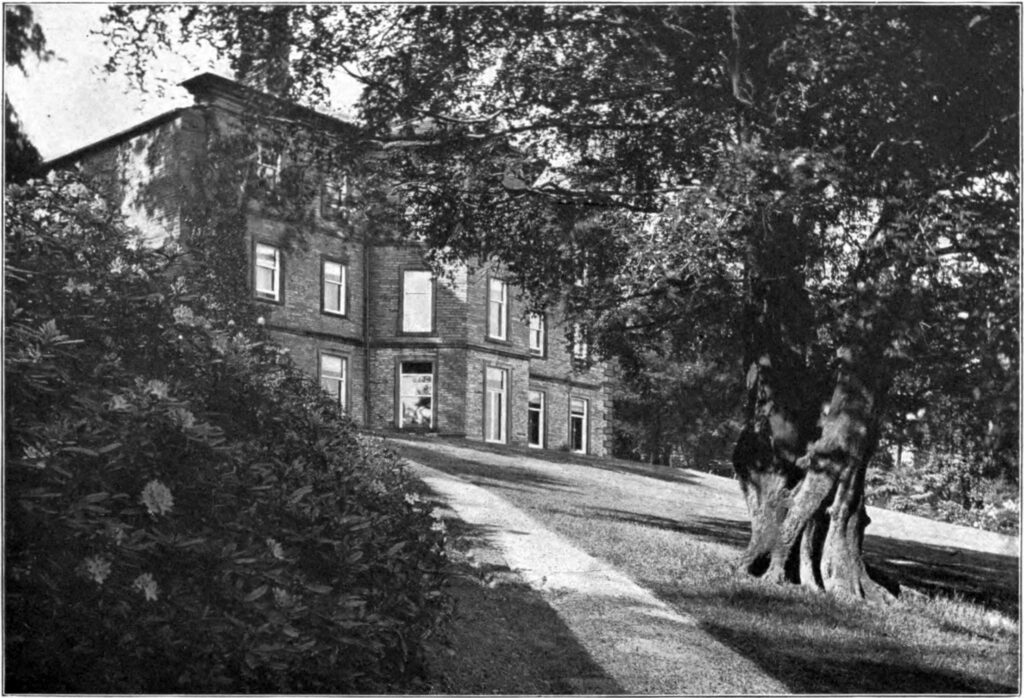
Charlotte worked for the Sidgwick’s as a governess for a short period, and lived in Stone Gappe in May and June 1839. She gave a detailed account of her time at Stonegappe in this letter to sister Emily Brontë (playfully referred to as Lavinia) sent on 8th June 1839:
‘Dearest Lavinia, I am most exceedingly obliged to you for the trouble you have taken in seeking up my things and sending them all right. The box and its contents were most acceptable. I only wish I had asked you to send me some letter-paper. This is my last sheet but two. When you can send the other articles of raiment now manufacturing, I shall be right down glad of them.
I have striven hard to be pleased with my new situation. The country, the house, and the grounds are, as I have said, divine. But, alack-a-day! there is such a thing as seeing all beautiful around you – pleasant woods, winding white paths, green lawns, and blue sunshiny sky, and not having a free moment or a free thought left to enjoy them in. The children are constantly with me, and more riotous, perverse, unmanageable cubs never grew. As for correcting them, I soon quickly found that was entirely out of the question: they are to do as they like. A complaint to Mrs. Sidgwick brings only black looks upon oneself, and unjust, partial excuses to screen the children. I have tried that plan once. It succeeded so notably that I shall try it no more. I said in my last letter that Mrs. Sidgwick did not know me. I now begin to find that she does not intend to know me, that she cares nothing in the world about me except to contrive how the greatest possible quantity of labour may be squeezed out of me, and to that end she overwhelms me with oceans of needlework, yards of cambric to hem, muslin nightcaps to make, and, above all things, dolls to dress. I do not think she likes me at all, because I can’t help being shy in such an entirely novel scene, surrounded as I have hitherto been by strange and constantly changing faces. I used to think I should like to be in the stir of grand folks’ society but I have had enough of it – it is dreary work to look on and listen. I see now more clearly than I have ever done before that a private governess has no existence, is not considered as a living and rational being except as connected with the wearisome duties she has to fulfil. While she is teaching the children, working for them, amusing them, it is all right. If she steals a moment for herself she is a nuisance. Nevertheless, Mrs. Sidgwick is universally considered an amiable woman. Her manners are fussily affable. She talks a great deal, but as it seems to me not much to the purpose. Perhaps I may like her better after a while. At present I have no call to her. Mr. Sidgwick is in my opinion a hundred times better – less profession, less bustling condescension, but a far kinder heart. It is very seldom that he speaks to me, but when he does I always feel happier and more settled for some minutes after. He never asks me to wipe the children’s smutty noses or tie their shoes or fetch their pinafores or set them a chair. One of the pleasantest afternoons I have spent here, indeed, the only one at all pleasant. was when Mr. Sidgwick walked out with his children, and I had orders to follow a little behind. As he strolled on through his fields with his magnificent Newfoundland dog at his side, he looked very like what a frank, wealthy, Conservative gentleman ought to be. He spoke freely and unaffectedly to the people he met, and though he indulged his children and allowed them to tease himself far too much, he would not suffer them grossly to insult others.
I am getting quite to have a regard for the Carter family. At home I should not care for them, but here they are friends. Mr. Carter was at Mirfield yesterday and saw Anne. He says she was looking uncommonly well. Poor girl, she must indeed wish to be at home. As to Mrs. Collins’ report that Mrs. Sidgwick intended to keep me permanently, I do not think that such was ever her design. Moreover, I would not stay without some alterations. For instance, this burden of sewing would have to be removed. It is too bad for anything. I never in my whole life had my time so fully taken up. Next week we are going to Swarcliffe, Mr. Greenwood’s place near Harrogate, to stay three weeks or a month. After that time I hope Miss Hoby will return. Don’t show this letter to papa or aunt, only to Branwell. They will think I am never satisfied wherever I am. I complain to you because it is a relief, and really I have had some unexpected mortifications to put up with. However, things may mend, but Mrs. Sidgwick expects me to do things that I cannot do—to love her children and be entirely devoted to them. I am really very well. I am so sleepy that I can write no more. I must leave off. Love to all. Good-bye. Direct your next despatch: J. Greenwood, Esq., Swarcliffe, near Harrogate. C. Brontë’
Again, despite the brevity of her time spent there, this building must have made an impression on Charlotte, for in 1931 the Leeds Mercury newspaper reported that her ghost was said to haunt there. In a wider article about the current usage of the hall, we find:
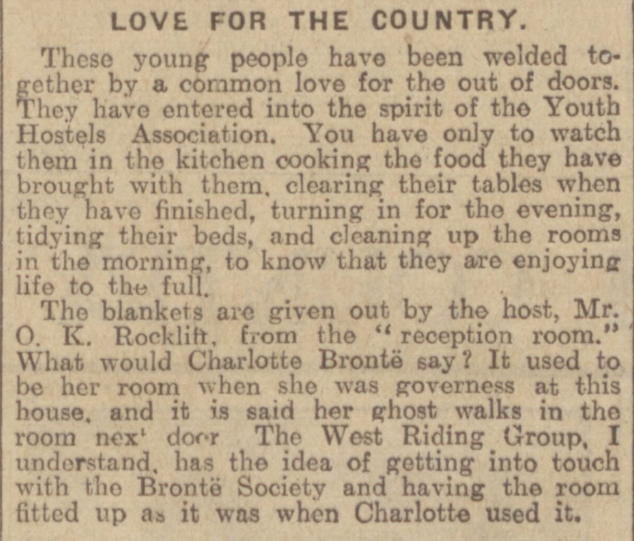
‘These young people have been welded together by a common love for the out of doors. They have entered into the spirit of the Youth Hostels Association. You have only to watch them in the kitchen cooking the food they have brought with them, clearing their tables when they have finished, turning in for the evening, tidying their beds, and cleaning up the rooms in the morning, to know that they are enjoying life to the full.
The blankets are given out by the host, Mr. O. K. Rockliff, from the “reception room.” What would Charlotte Brontë say? It used to be her room when she was governess at this house, and it is said her ghost walks in the room next door. The West Riding Group, I understand, has the idea of getting into touch with the Brontë Society and having the room fitted up as it was when Charlotte used it.’
It’s said that this is the most liminal time of the year, when the veil between our world and the next is at its thinnest and when ghosts are most likely to appear. If you feel a chill right now, turn the heating on, and if that doesn’t work turn slowly around: you may just see Charlotte Brontë’s ghost! I hope to see you next week for another new Brontë blog post – don’t have nightmares.
Haha, the only ghost I believe in is The Holy Ghost.
A delightful,autumnal addition.
Must exlkore the Yha connection as being a hosteller is not so new as a Bronte lover.
Thank you 🍁🍂
I so enjoy these.
Thank you Virginia!