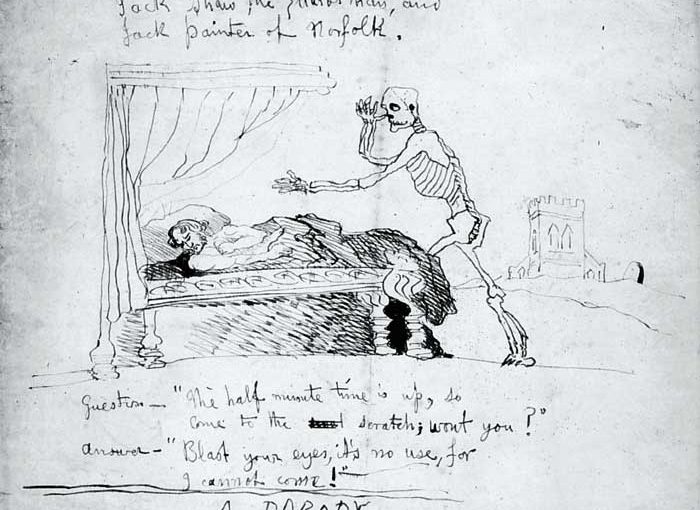
When we traverse the story of the Brontë family we encounter great triumphs: never before and never again will three siblings from such seemingly inauspicious backgrounds achieve so much in the field of literature. It was a family blessed by genius, but it was also a family touched by tragedy. Epitomising this is Branwell Brontë, and today we will look at a detailed account of the final encounter with him from one of his greatest friends.
Branwell had talent himself, he could perhaps have been a fine artist or fine poet if he had been able to apply himself fully to those arts, but we will never know – he fell victim to demons that he was unable to shake off.

There can be no doubt that in his later years Branwell Brontë must have made life in Haworth Parsonage very difficult for his sisters and father, but in his earlier years he had been a very affectionate and kind brother. He died on this week in 1848, aged 31; it proved a warning shot, as within eight months the tuberculosis that claimed him also led to the deaths of his younger sisters Emily and Anne Brontë. Tomorrow, the 28th of September, marks the anniversary of his funeral.
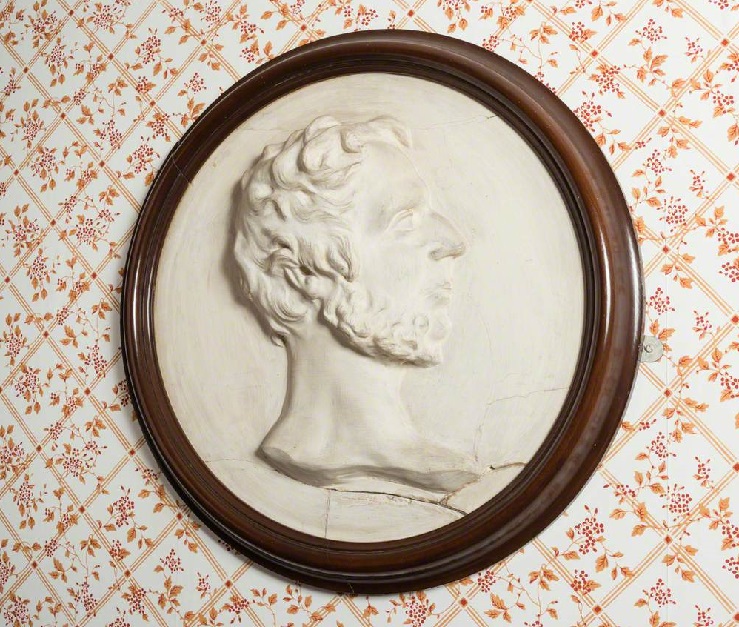
At his best, Branwell could be a gregarious individual. He was well liked among the Haworth villagers, not always an easy bunch to please, and made close friends in village sexton John Brown, sculptor Joseph Bentley Leyland and railway engineer Francis Grundy. It is Grundy, in his own memoir that devotes a chapter to Branwell, that gives a detailed and at times harrowing description of his final encounter with his friend:
‘As he never came to see me [Grundy had invited Branwell to visit him in Skipton], I shortly made up my mind to visit him at Haworth, and was shocked at the wrecked and wretched appearance he presented. Yet he still craved for an appointment of any kind, in order that he might try the excitement of change; of course uselessly. I now heard his painful history from his own lips, – his happiness, his misery, and the sad story which was the end. He was miserable. At home the sternness of his father had never relaxed, and he was unfitted for outside social companionship. He was lost now, for he had taken again to opium.
Very soon I went to Haworth again to see him, for the last time. From the little inn I sent for him to the great, square, cold-looking Rectory. I had ordered a dinner for two, and the room looked cosy and warm, the bright glass and silver pleasantly reflecting the sparkling firelight, deeply toned by the red curtains. Whilst I waited his appearance, his father was shown in. Much of the Rector’s old stiffness of manner was gone. He spoke of Branwell with more affection than I had ever heretofore heard him express, but he also spoke almost hopelessly. He said that when my message came, Branwell was in bed, and had been almost too weak for the last few days to leave it; nevertheless, he had insisted upon coming, and would be there immediately. We parted, and I never saw him again.
Presently the door opened cautiously, and a head appeared. It was a mass of red, unkempt, uncut hair, wildly floating round a great, gaunt forehead; the cheeks yellow and hollow, the mouth fallen, the thin white lips not trembling but shaking, the sunken eyes, once small, now glaring with the light of madness, – all told the sad tale but too surely. I hastened to my friend, greeted him in my gayest manner, as I knew he best liked, drew him quickly into the room, and forced upon him a stiff glass of hot brandy. Under its influence, and that of the bright, cheerful surroundings, he looked frightened – frightened of himself. He glanced at me a moment, and muttered something of leaving a warm bed to come out into the cold night. Another glass of brandy, and returning warmth gradually brought him back to something like the Brontë of old. He even ate some dinner, a thing which he said he had not done for long; so our last interview was pleasant, though grave. I never knew his intellect clearer. He described himself as waiting anxiously for death – indeed, longing for it, and happy, in these his sane moments, to think that it was so near. He once again declared that that death would be due to the story I knew, and to nothing else.
When at last I was compelled to leave, he quietly drew from his coat sleeve a carving-knife, placed it on the table, and holding me by both hands, said that, having given up all thoughts of ever seeing me again, he imagined when my message came that it was a call from Satan. Dressing himself, he took the knife, which he had long had secreted, and came to the inn, with a full determination to rush into the room and stab the occupant. In the excited state of his mind he did not recognise me when he opened the door, but my voice and manner conquered him, and ‘brought him home to himself,’ as he expressed it. I left him standing bare-headed in the road, with bowed form and dropping tears. A few days afterwards he died.’

Grundy concluded his memories of Branwell Brontë by saying: ‘Patrick Branwell Brontë was no domestic demon – he was just a man moving in a mist, who lost his way.’ May we all avoid the mists as we make our own ways through the pathways of life. I hope to see you next Sunday for another new Brontë blog post.