
Through the Brontë novels we learn about the world they lived in, and also about the world we live in. Their timeless books are full of wisdom that transcends the ages and teaches us about what it means to be a human and therefore prey to all the human emotions, virtues and vices we know so well. All of the Brontë novels also contain, to a greater or lesser extent, autobiographical features, but if we want to know more about their lives, without the mask of literature filtering it, we do well to turn to their letters.
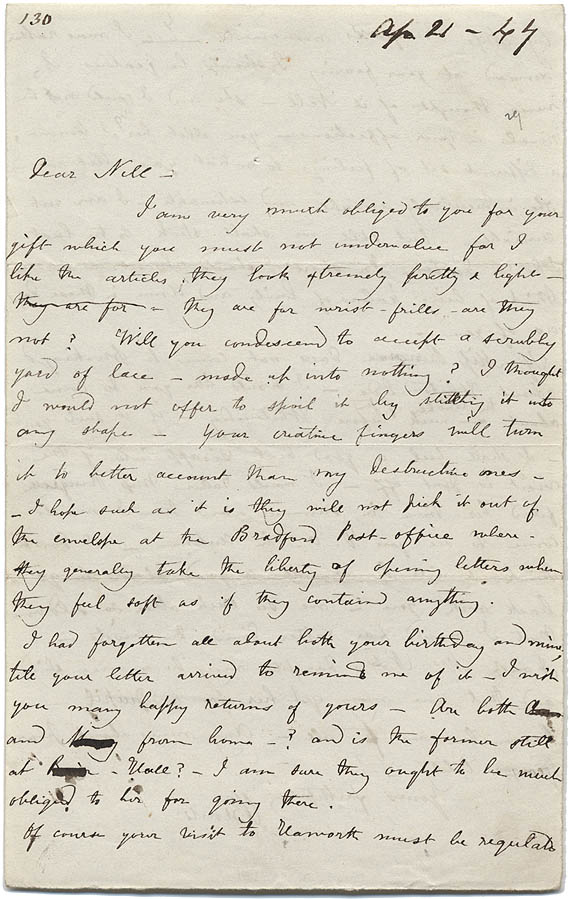
Charlotte Brontë was the most prolific letter writer, we have far more letters from her than from her brother or sisters available to us today. We can’t know for sure when her first letter was written, but we know that the earliest extant Brontë sibling letter was written from Charlotte Brontë to her father Patrick Brontë on 23rd September 1829, when she was 13 years old. In it, she also mentions her siblings Branwell, Emily and Anne, as well as her Aunt Elizabeth (Aunt Branwell). I present it to you below:
‘To the Revd Patrick Brontë, 23 September 1829, Parsonage House, Crosstone
My Dear Papa,
At Aunt’s request I write these lines to inform you that if all be well we shall be at home on Friday by dinner time, when we hope to find you in good health. On account of the bad weather we have not been out much, but notwithstanding we have spent our time very pleasantly, between reading, working and learning our lessons, which Uncle Fenell has been so kind as to teach us every day, Branwell has taken two sketches from nature, & Emily, Anne & myself have likewise each of us drawn a piece from some views of the lakes which Mr Fenell brought with him from Westmoreland, the whole of these he intends keeping. Mr Fenell is sorry he cannot accompany us to Haworth on Friday for want of room, but hopes to have the pleasure of seeing you soon, all unite in sending their kind love with your,
Affectionate Daughter, Charlotte Brontë’

The Brontë children have been taken by their aunt to spend a few days in Crosstone (now more usually called Cross Stone) near Todmorden, on the Yorkshire and Lancashire border, about 11 miles from Haworth. They have been staying at the parsonage home of Reverend John Fennell. The Cross Stone church of St. Paul is shown at the head of this post.
Uncle Fenell, as Charlotte mis-spells him, is actually great uncle to the Brontës, having married Jane Branwell, aunt to their mother Maria. It was these Fennells who set up the school in Woodhouse Grove near Leeds where Patrick Brontë and Maria Branwell first met each other in 1812. By the time of the visit mentioned in Charlotte’s letter, John Fennell is a widower after the death of Jane four months earlier, and he has been ordained as a parish priest in the Church of England. It seems the children, ranging in age from Charlotte at 13 to 9 year old Anne, enjoyed their visit, and no doubt their great uncle enjoyed it too as he continued to cope with his loss.
Of the pictures referred to in the letter, some believe that this image of Cockermouth (the Lake District town which was the birthplace of William Wordsworth) by Charlotte is her ‘piece’ sketched from the pictures Reverend Fennell brought him with from the Lakes, although other believe that this very detailed image must date from a later year. It’s a beautiful image created by Charlotte, nonetheless.

From this little acorn of a letter mighty oaks would grow, as Charlotte Brontë has to be considered one of the greatest literary letter writers of all time. In this age of emails the art of letter writing is vanishing forever, but I hope to see you next week for another new Brontë blog post.